Posts

Showing posts with the label St Andrew

St Andrew's Day 2018
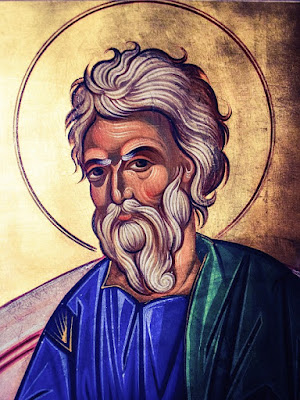
Image
How did a 1st century Jewish man from Bethsaida in Galilee, whose parents gave him a Greek name, get to be the Patron Saint of Scotland? And why, in Scotland, is today 30 November a public holiday, supposedly in honour of St Andrew the Apostle? There are many stories and legends that answer those questions. One good place to start to look for an answer is Michael Turnbull's article 'A History of St Andrew'. This is probably a good day to eat fish, as Andrew was a fisherman, as was his more famous brother Simon Peter. St Andrew is a key figure in the gospel accounts. Andrew is not presented as obviously important among J esus' disciples - not as one of the inner 3 like Peter, James and John. I say St Andrew is a key figure because he had a gift for bringing people together and for bringing people to Jesus. The gospels record that Andrew told his brother Peter about Jesus  (John 1: 35 - 42) brought a boy with a few loaves and fishes to Jesus   (John 6: 1 ...

St Andrew's Day Rambling Roundup

Image
Image Credit I planned to write something clever and wise for St Andrew's Day. I haven't. I'm still making a priority of resting after a recent operation. So instead of what I intended, here is a rambling miscellany of thoughts and links to other posts. Firstly, why the image of aeroplane vapour trails? What has that got to do with St Andrew's Day, apart from the idea that Andrew was martryed on a diagonal cross? A diagonal white cross allegedly appeared in a blue sky on the morning of the battle in  832 A.D. between Angus (Oengus), King of the Picts (helped by the Scots) and Athelstane, the Saxon King of Northumbria. According to a story written by Walter Bower (1385 - 1449) King Angus prayed to St Andrew on the eve of the battle. The next day King Athelstane fled from the field and Athelstane was killed near what is now the village of Athelstaneford. Because of this story, the village now prides itself as being the birthplace of the Saltire , Scotland's nati...

St Andrew's Day

Image
Scotland's national flag, the Saltire, is a symbol of St Andrew, the nation's patron saint. The diagonal cross alludes to Andrew's death by crucifixion. Andrew of course was not Scottish and never visited Scotland. He was a Jewish fisherman from Galilee who responded to Jesus' call to follow him and brought his rather more famous brother Simon Peter with him. It's St Andrew's Day today. It's the only saint's day I remember being celebrated in the Presbyterian church in which I grew up, whose membership was dominated by ex-patriot Scots like my grandparents. Consequently as a child I thought St Andrew was the most important of the first 12 apostles. In the eastern orthodox church he's known as the 1st-called. But in Scotland his importance is more entangled with national identity and often with the struggle for independence - see Flavia di Consiglio's article today for the BBC 'Who owns St Andrew's Day?'  . 1200 years ago in Scot...

Mediation and St Andrew

Image
Whatever you think about today's one-day strike of public sector employees in the UK , you'll probably agree that a useful person in a dispute is a good mediator - who brings people together, gets to know the issues and those involved well enough to help them find common ground, listen to one another and  negotiate.  Today is St Andrew's Day. The apostle Andrew, one of the first disciples Jesus chose, is remembered for bringing people together. Specifically, the gospels record that Andrew told his brother Peter about Jesus (John 1: 35 - 42) brought a boy with a few loaves and fishes to Jesus (John 6: 1 - 15) told Jesus about foreigners wanting to meet Jesus (John 12: 20 - 26) Andrew didn't do anything extraordinary, just what all Christians are called to do. He passed on to others what he had seen, heard and experienced of Jesus. He brought people to Jesus and he told Jesus about people who wanted to meet him. In the end, tradition has it that it cost Andrew hi...

Alarming or helpful?

Image
Do you notice signs? This one made me stop to giggle because of its ambiguity. Why is this roof alarmed? It's very high and very big so what could possibly have alarmed it? Low-flying aircraft? Migrating geese? Woodworm in the rafters? Bats in the belfry? Most likely the latter. The roof in question is a rural medieval church roof. On the other hand the notice probably means the roof has been fitted with an alarm system to deter lead and copper thieves - a major problem round our way. The image is just part of the notice on the board outside the church. The other part tells which security company to phone if you need to climb on the roof. Lead and copper thieves need not apply. Gutter clearers and roof restorers welcome. Signs that warn of alarmed rooves or badgers on the road are useful. So are signs that point the way you might want to go. But who would want to go here? "TO THE EDGE" Some signposts are just confusing, giving no clear direction at all, lik...