Posts

Showing posts with the label saints

St Augustine of Hippo

Image
Today is the Feast Day for St Augustine of Hippo (354 - 430 A.D.). He was of Berber origin, born in modern day Algeria. His mother Monica was a Christian and his father Patricius a pagan. After a wayward youth he converted to Christianity in 386 A.D. Thanks to his early education in rhetoric and philosopy, he became a writer in philosophy and theology. His written work continues to have great incluence on Western Christianity, for example in the way he developed the concept of 'original sin' and his emphais on the concept of divine grace as essential to salvation. He has been both condemned and admired by later Christian thinkers. He is often quoted as an authority, but he had a realistic and humble view of his limitations.  My favorite story about him is how he wrestled to understand the Christian doctrine of the Trinity. Don't we all? He wanted to be able to explain it. Can anyone? Here's my version of the story: As Augustine walked by the sea shore he saw a child al...
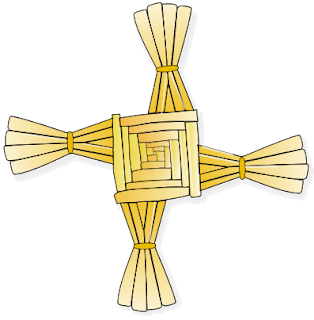
Brigid, Abbess of Kildare

Image
  I know little about Irish saints. I've only recently discovered that the republic of Ireland now honours St Brigid along with St Patrick as the country's 2 patron saints. Today is St Brigid's feast day. Starting next year, in Brigid's honour there will be a public holiday on the Monday nearest to 1 February, giving her equal status (as far as public holidays go) with St Patrick whose feast day has been a public holiday there for a long time. In the Church of England she is commemorated today as Brigid, Abbess of Kildare, who died about 525 A.D. I've chosen a cross of reed straw to illustrate this post. It's a cross associated with St Brigid because of the legend about her sitting with a dying pagan lord, possibly her father. As she sat in vigil by the bedside she picked up some rushes from the floor and wove them into a cross while explaining the meaning of the cross of Jesus Christ to the dying man. The story goes that the man died peacefully having converted...

Mary Magdalene's Feast Day

Image
This modern icon of Mary Magdalene was written by Brother Robert Lentz. It is in Grace Cathedral in San Francisco. I'm posting this image today because it is the feast day of Mary Magdalene. The Syrian inscription means 'Equal to the Apostles'.  Icons are intended to be like windows through which we may glimpse something glorious. They point beyond the image of the saint, to encourage the one who contemplates it to worship, not the saint, but God. In this icon, Mary Magdalene is pointing with her right hand to the egg held in her left. In some Christian traditions an egg is a symbol of the resurrection of Jesus. According to John's Gospel, Mary Magdalene was the first apostle of Jesus' resurrection. She, with other spice-bearing women were the first to discover the empty tomb on the 3rd day. In the garden near the tomb, Mary Magdalene had a special enounter with the risen Christ and rushed to tell the disciples, "I have seen the Lord". They didn'...

Cuthbert and self isolation

Image
On this day 20 March in 687 AD St Cuthbert died in his hermit  cell on Inner Farne Island. So today is St Cuthbert's Day in honour of one of the most popular saints of Britain. I think he might have had much to teach us about making the best use of physical isolation from others. In his youth Cuthbert cared for sheep, either as a shepherd boy, or as a guard for the flock. That surely must have involved a lot of solitary time. Later, having had a vision as a child that made him decide to dedicate his life to God, he became a monk. Eventually he became Abbott of Lindisfarne and then a Bishop. As a bishop he travelled and preached as he walked over the rough hills of his diocese. In between those journeys he spent time as a hermit on Farne Island - chosen self-isolation in order to deepen his relationship with God and so be more useful to those who needed his spiritual guidance.  For Cuthbert, to be human was to live in dependence on God, aware of his constant presence. You...

Mixed up Saints with Broken Halos: Reflection for All Saints Day

Image
Can you understand the pictures in this photo of a stained glass window? The image is a small part of the enormous window above the west door in Winchester Cathedral (UK). Seeing the whole window does not help to interpret the pictures. The window contains a jumble of irregularly shaped coloured glass. You might be able to pick out the odd face or hand and if you know what you are looking for, a lot of broken golden halos. The west window is not the original. The original medieval window had Bible stories and images of saints. During the English civil war, on 12 December 1642, Cromwell's soldiers destroyed many things in the cathedral, leaving it without glass in the windows and with holes in the roof. If you want to know what happened, do take a look at the dramatic story from Winchester Cathedral's website, as written for schoolchildren here in 'The story of the Great West Window' . To cut a long story short, horrified Winchester residents collected and sec...

Mary Magdalene: thoughts on her feast day

Image
Today 22 July is the feast day of St Mary Magdalene. I love this image of a detail of a mosaic in the Resurrection Chapel in Washington National Cathedral, D.C in the USA. It shows Mary Magdalene meeting the risen Jesus Christ. Mary Magdalene has been the subject of so much speculation, denigration, imagination and admiration over the last 2000 years, it's hard to sort truth from legend and fiction. I prefer to stick to what the 4 Gospels in the New Testament tell us about her and also notice what they do not tell us. Here is who Mary Magdalene was not: Mary Magdale was not one of the other Marys in the New Testament e.g. Mary mother of Jesus or Mary sister of Martha and Lazarus of Bethany. Mary Magdalene was not a prostitute, although she has been portrayed as such. Mary Magdalene was almost certainly not the anonymous sinful woman who annointed Jesus' feet in the house of Simon the Pharisee. Mary Magdalene was not Jesus' wife or mother of his child. ...

St Andrew's Day 2018

Image
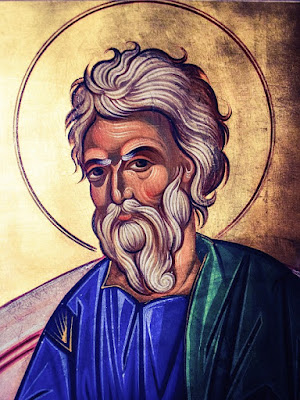
How did a 1st century Jewish man from Bethsaida in Galilee, whose parents gave him a Greek name, get to be the Patron Saint of Scotland? And why, in Scotland, is today 30 November a public holiday, supposedly in honour of St Andrew the Apostle? There are many stories and legends that answer those questions. One good place to start to look for an answer is Michael Turnbull's article 'A History of St Andrew'. This is probably a good day to eat fish, as Andrew was a fisherman, as was his more famous brother Simon Peter. St Andrew is a key figure in the gospel accounts. Andrew is not presented as obviously important among J esus' disciples - not as one of the inner 3 like Peter, James and John. I say St Andrew is a key figure because he had a gift for bringing people together and for bringing people to Jesus. The gospels record that Andrew told his brother Peter about Jesus  (John 1: 35 - 42) brought a boy with a few loaves and fishes to Jesus   (John 6: 1 ...

St Cecilia's Day and the March of the Thumbs

Image
Why am I remembering the 'March of the Thumbs' on St Cecilia's Day? Well, St Cecilia is known as the patron saint of musicians and I am thinking about the significance of music in my life. The 'March of the Thumbs' was a memorable step in my musical development. I can still remember the excitement of my first formal piano lesson when I was about 5 or 6 years old. In that lesson Miss C taught me how to play the first piece in the beginners' piano tutor book - not only how to play it but also how to play while reading the music from the stave. I already had a love for the piano because my mother played it well. The sense of accomplishment at mastering that first lesson and performing it later to family and neighbours set me on a pianistic journey of progress, setbacks, ups and downs. Like life really - sometimes developing gifts and other times neglecting them. The March of the Thumbs only needed the thumbs of each hand, used alternately to perform it. An...

5 ways to celebrate St Luke's Day

Image
18th century Icon Russian Orthodox Today, 18 October is the feast of Luke the Evangelist. He is also known as St Luke. Are you marking this day?  If so, how? Here are 5 ways to celebrate Luke's Day: 1. Celebrate St Luke with food. St Luke by Pordenone Some people like to eat beef of St Luke's Day. That is because of the tradition that since early Christianity Luke's Gospel (and its writer) has been identified with the winged bull or ox, one of the 4 living creatures around God's throne, described in John's vision in Revelation. 2. Celebrate St Luke with reading Tradition attributes the Gospel of Luke and its sequel the Acts of the Apostles to Luke the physician and evangelist companion of Paul on some of his missionary journeys. Reading at least some of those books would be a fitting way to honour him. Luke's message is the message of Jesus - good news for all people, including people seen by others as outsiders. That me...

Maximilian Kolbe (1894 - 1941)

Image
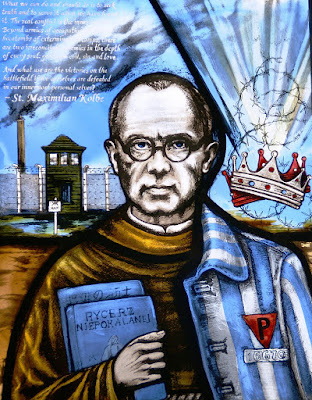
Maximilian Kolbe died in Auschwitz Concentration Camp on 14 August 1941. He died horribly after volunteering to take the place of another prisoner selected for death by dehydration and starvation. You can read a brief version of that story in  'Man in Striped Pajamas'. During World War II as a Polish Franciscan Friar, Maximilian Kolbe sheltered refugees from Greater Poland, including 2000 Jewish people in his friary at  Niepokalanów. Using amateur radio he also actively spoke against Nazi activities. Such actions led to his arrest, imprisonment and death. He was canonized by Pope John Paul II in 1983 as a 'martyr of charity'. At the ceremony in Rome, perhaps the most significant person present was Franciszek Gajowniczek. He was the prisoner whose place Maximilian took in offering his own life in exchange. That man survived Auschwitz and lived until 1995, aged 93. You can read an interesting biography of Maximilian Kolbe in the Jewish Virtual Library .  From...

Clare of Assisi, Founder of the Minoresses (Poor Clares)

Image
Who was Clare of Assisi? Was St Clare a teenage rebel who ran away from her wealthy home in Assisi? If that's what St Clare did in the early 13th century, why is she still remembered today, the day of her death, 11 August? Why is Clare of Assisi also known as St Clare? And what is her connection with St Francis of Assisi? Are you like me, you don't know much about St Clare? Would you like to know more? And you don't want to get bogged down in too much theological or academic writing? Is so, you will find a simple starting point on the 'Our Roots' page of 'The Poor Clare Monastery, Hereford.  This tells you a little about St Francis as well. It is hard to understand Clare of Assisi without knowing something of the inspiration for simple Christian living that Clare found through the preaching of Francis of Assisi. The way of Francis, following in the way of Christ, inspired St Clare to found an order of contemplative nuns, known in her lifetime as ...

On the 5th day of Christmas Thomas Becket was murdered

Image
At dusk on this day 29 December in 1170 Thomas Becket, Archbishop of Canterbury was murdered by 4 of the King's knights. This photo shows the place in the cathedral where Thomas Becket was murdered. A latter day pilgrim has placed a rose on the small altar in his honour. The knights believed they were doing what the king wanted by getting rid of the man King Henry II had described as "this turbulent priest". Thomas Becket was a great friend of the King Henry II but defended the independence of the Church against the King's wish to have more monarchical control of the church. The disagreement, fuelled perhaps by personality clashes, lasted for years. For more on the story leading up to the murder take a look at Richard Barber's article,  'The unholy feud that killed Thomas Becket'. Thomas was neither the first nor last Archbishop of Canterbury to be murdered, but he was the only one murdered in his own cathedral while engaged in prayer, probably s...

St Nicholas Day 2016

Image
Today Google invites me to "skydive with Santa and boogie with elves in Santa's Village".  No thank you.   Doesn't Google know it's St Nicholas' Day today? Not even the legends about St Nicholas have any reference to sky-diving or boogieing with elves. Yes I know I'm starting to sound like Scrooge saying 'bah humbug' to the whole Christmas merriment. I will be celebrating Christmas - but not yet - apart from the odd mince pie which I couldn't possibly refuse when offered. Today is the day to celebrate the original Santa Claus, Sinterklaas, Saint Nicholas, St Nikolas - take your pick of names according to your language preference. It's the Feast of St Nicholas today. (Except in some places where it was yesterday). It's traditional to celebrate Christian saints on the date (or supposed date) of their death. For St Nicholas that was 6 December AD 343. He died in Myra (in modern Turkey) where he was a Bishop. In iconography S...

St Cecilia's Day

Image
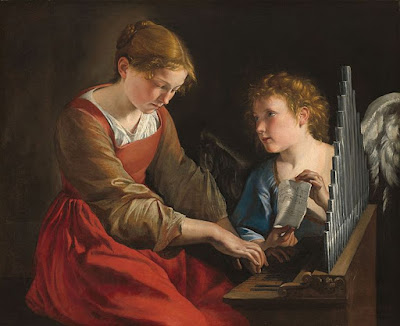
St Cecilia is known as the patron saint of musicians and it is her feast day today 22 November. This painting of St Cecilia and an angel by Orazio Gentileschi (1563 - 1639) and Giovanni Lanfranco (1582 - 1647) really appeals to me. The young woman is concentrating so carefully on playing her organ. The angel is holding the manuscript but Cecilia is not looking at it. Her expression is sad and she seems to be hearing an inner voice to which she is responding. St Cecilia is often portrayed accompanied by an angel. The reason for that lies in the mythical stories about her. She is supposed to have been one of the Christians martyred under the Romans, possibly in Sicily or Rome in the 2nd or 3rd Centuries A.D. The pious legends about her date from the 5th and 6th centuries. You can read one account here . Since she is known as the patron saint of musicians I think one way to celebrate her day is to listen to part of Handel's Ode to St Cecilia and look at some more visual im...

Was Luke the Evangelist also an artist?

Image
Was Luke the Evangelist also an artist? The detail image shown above is from a stained glass window in Dublin's Christ Church Cathedral. It is in the Chapel of Laurence O'Toole and shows St Luke drawing or painting. It was created by Patrick Pollen in memory of his teacher Catherine O'Brien who died in 1963. Some people venerate St Luke as the patron saint of artists. This is because of a Christian tradition from the 8th century onward that Luke painted the first Icons of the Virgin Mary and Jesus. There are legends supporting this idea and paintings showing Luke painting the Madonna and Child, for example this anonymous Russian icon. Was Luke an artist? There are icons of the Virgin Mary and the Christ child whose origins are attributed to Luke. You can even find a catalogue of them here . Personally, I am highly sceptical that many or any can be traced back to Luke. The historical evidence is slim to say the least. So, I do not know if Luke created any paintin...

Mary, Martha and Lazarus

Image
Today the church remembers 'Mary, Martha and Lazarus, Companions of our Lord'. I am not sure why Mary's name is placed first for today. Perhaps the order is alphabetical. Mary, Martha and Lazarus were 2 sisters and their brother.   These 3 were friends of Jesus, providing a welcome for him in their home at Bethany near Jerusalem.  John 11: 5 tells us that "Jesus loved Martha and her sister and Lazarus." Much of Jesus' 3 years of ministry was itinerant. With his disciples he walked from place to place, not always knowing where he would sleep. The hospitality of those who would open their homes to him was vital. When the people doing that were true friends then such hospitality would feel very precious. After a hard day, what better than to relax in a welcoming home in the company of the most trusted and loved friends, like Mary, Martha and Lazarus? During a visit to to the Holy Land a few years ago I noticed  a plaque outside the church of St Lazar...