Posts

Showing posts with the label environment

Lent thankfulness:facial tissues

Image
I am fighting a cold virus and finding it harder than usual to feel gratitude. As explained here I aim to notice something to be thankful for each day this Lent. Today is the 3rd day. Today as I sniffle and sneeze I am grateful for paper hankies (or facial tissues if that's what you call them). I'm thankful for being able to take a soft dry one out of the box when I need it, rather than re-use a damp and snotty cotton handkerchief. I'm thankful that I don't have to wash them. They will all be composted at the bottom of our garden among the vegetable peelings and garden waste. The heat will kill the bugs as the paper decomposes before being spread with the matured compost on the vegetable garden. Doing that makes me feel slightly less guilty about whether the manufacture of paper tissues is ecologically ethical. The box I'm using claims that the manufacturers source from well-managed forests, but I still have questions - not enough to stop me using paper hankie...
Bird-watcher sets cat among pigeons

Image
Do you hate trite answers to deep questions? From babyhood we construct mental patterns to help make sense of what is around us. With language we gain (illusory) control of the world. By 3 or 4 we ask questions that begin 'why' as often as with 'what'. Some of the 'why' questions are easily answered, some not. I think one of the tasks of adulthood is to go on asking questions and learn to live with questions with no answers, or no answers yet. This also applies to maturing in faith. Most of the world's religions provide some answer to the difficult questions of life or a way of living with them that gives meaning and purpose. I believe God is the Creator of all that there is. This gives rise to some of the biggest questions - and I'm not talking about any supposed conflict between scientific and Biblical ideas of the origins of the universe and humanity's place within it. The biggest question for me is 'why suffering?' When suffering ...

Green Beans from Egypt?

Image
What's the best thing to do? Should you always buy locally grown and in season fruit and vegetables? My gut feeling tells me that's the right thing to do for the sake of the planet. If I buy green beans in winter for example - which I sometimes do - I feel guilty. Should I? Today the Christian Aid 'Count Your Blessings' calendar tells me "COC Bless in Egypt has trained farmers to grow green beans for export to Europe, earning them five times the local market price." If this means that poor farm ers can make a living wage I can see that's good in the short term, but what about other unintended consequences of this? I've no time to consider that further today. I'd welcome your comments. Christian Aid is suggesting giving 10p for any fruit or vegetable you bought this week that was not grown in Britain. I can't help feeling this is a fine for doing a 'bad' thing i.e. not using local suppliers. Or is it meant to be a gift i...

What would your ideal world look like?

Image
The problem with having a vision for an ideal world is that it can seem so divorced from what we see now as to be completely unattainable. You might apply that to Christian Aid's picture given in the Count Your Blessings calendar of an ideal world in 2030:  "free from poverty and the effects of  climate change" . Do you, like me, find yourself thinking that the world has never been free from poverty or that climate change is happening and always has however people try to change it? Or that the problem is so big, how can anything 1 person or even 1 nation do to change things? The problem with not having a shared vision of an ideal world is that nobody bothers to do anything about gross injustice or the threats to the health of our planet that we can do something about. Many of the poorest people in the world are already suffering from the effects of climate change such as rising sea levels, drought, extremes of weather. Christian Aid is not suggesting giving mon...

Ducks pay for schooling

Image
The village where I live used to be wetter than today. It still has village ponds, like the one in this photo, but fewer than before. Areas that used to be water-logged or flood are drier due to improved drainage. Availability of communal ponds encouraged cottagers of past times to rear ducks to supplement their incomes as poorly-paid agricultural labourers. The ducks would spend their days on a pond and walk home to their owners to be shut up at night. The ducks are still thriving but most of the cottages of the poor are now 'gentrified'. You need more than back-yard duck-rearing to pay for them. People in water-logged areas of Bangladesh find duck-rearing useful in trying to make a living wage. In Bangladesh today are areas where rivers and groundwater have become salty as a result of climate change. Sea levels are rising, so fresh water near the coast is being salinated. This is making farming by traditional methods harder. One alternative being introduced by CCDB is ...

What does 9 tonnes of CO2 look like?

Image
I had absolutely no idea what 9 tonnes of carbon dioxide looks like, until I looked at this representation of only one tonne in Copenhagen According to the Count Your Blessings Lent calendar from Christian Aid:  9 tonnes is the amount of carbon dioxide generated in Britain by each person per year. So imagine this giant balloon times nine. Or imagine a 27 metre square cube times 9. Here's a 27 metre square cube in a multimedia  art installation in Copenhagen. In Nicaragua each person generates 0.8 tonnes. This central American country is feeling very keenly the effects of climate change, less predictability of weather patterns and greater extremes. You can read about this on this page from Oxfam . Christian Aid suggests today that you give 50p for every flight you have taken in the last 12 months. I've taken 2 (short-haul) flights, so that's £1. 

A trillion plastic bags a year

Image
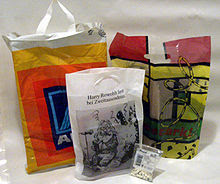
In a week where the focus is caring for the environment, Christian Aid's Count Your Blessings Lent calendar highlights plastic bag use and suggests you give 50p if you have accepted a plastic bag in a shop this week. I was about to say I haven't. I use jute bags or heavy-weight reuseable plastic bags. Then I remembered the several single-use plastic bags I'd used for fruit and vegetables in the supermarket. So my total today should probably be £2.50.  According to Green England a trillion plastic bags each year are used world-wide of which the UK uses 10 billion. Most are only used once and some take as much as 1,000 years to degrade into a plastic dust which can continue to contaminate. Plastic bag litter has a devastating effect on wild-life. It does seem this is a complex issue. If re-cycling is done responsibly, it's not a simple matter of plastic bags = bad, paper and fabric bags = good. For example paper and cotton bags use more energy resources in prod...

Raspberries and adapting to climate change

Image
For Northern hemisphere readers here's a foretaste of summer with these succulent raspberries - one of my favourite fruits. Enjoy! This is another day of 'Count Your Blessings' with Christian Aid's Lent calendar 2012 - and the end of a week about change. Providing tools for people to create their own change is key to Christian Aid's work. Working in 47 countries it uses more than 500 partner organisations to empower local people to effect positive change in response to local needs. For example: Christian Aid has 10 partner organizations in Tajikstan . With the collapse of the Soviet Union 20 years ago and a 5 year civil war this country has faced increasing poverty. This is as a result of a deteriorating infrastructure, decline in state-supported services and high unemployment. Food production is threatened due to climate change with more unpredictable weather and rising temperatures. Of a population of 7 million about 2 million have left to find work i...

Change and changing environment

Image
How much time do you spend on the internet, for work or leisure? Some, obviously, or you wouldn't be reading this. 82% of the British population are now internet users, compared with only 0.2% of the population in Mali. But then, of its 12 million population only 22.9% are literate. Mali is a large land-locked West African country and one of the poorest in the world. Today Christian Aid's 'Count Your Blessings' calendar starts a week about transformation, a "week for change". Christian Aid's work in Mali is about change and adapting to a changing environment, described on their website like this: As Mali’s climate becomes increasingly dry, we’re supporting small-scale farmers adapt to the changing environment. These new methods not only build communities’ resilience to climate change, but protect the fragile environment. We’re also leading the way in developing green energy, creating new ways for people living far from the capital, Bamako, and the ...

Life-giving Trees

Image
I'm watching a pair of red kites flying to and from the top of a tree I can see from my study window. They are carrying huge twigs as they build this year's nest. I tried last year to capture this in a photo, but my camera isn't up to it. If you've taken a good photo of a tree you could use it to help 'A Rocha' International plant 800 trees in Ghana where since 1990 one quarter of its forest cover has been felled.  Here's how . Their free environment resource pack for use by churches is 'The Life of Trees and The Tree of Life' . It's coming soon, ready for World Environment Day on 5 June. It should be worth a look.  What a dreadful misuse of our planet that collectively we humans have cleared so much forest, often without thought to replacement or the devastating environmental results. The most widely recognized symbol of Christianity (the cross) is a felled tree. What a dreadful misuse of a valuable resource to crucify someone on a tree.  ...

Flushing Liquid Gold

Image
Do you flush your urine down the loo? You do? Shame on you. So do I. Shame on me, when I could, but don't, use it for valuable purposes, such as: soaking my tired dry feet in it so the skin becomes baby smooth removing grease from my clothes (like the Romans until they got soap from the Germans) making my home-made bread rise and my beer foam making fireworks or other explosives making an emergency gas mask like the soldiers in the trenches at Ypres (actually not a good idea - the reaction with ammonia just made things worse) using it as a mordant to prepare cloth for dyeing using it to remove hair from dead animal skins I will let you into a secret. Urine from someone living with me is occasionally (and discreetly) used as a garden compost accelerant. It's effective and much cheaper than anything you might buy in the garden centre. I don't contribute because our compost bins are too tall for me. I just remain so grateful for the invention of the Wat...

Disaster under your Nose

Image
Photo from onion.com It 's h appening under your nose (and mine). It's a "crisis of catclysmic proportions " that could be the "greatest environmental disaster" in the history of the United States, according to a brilliantly ironic news article published by onion.com. I enjoy irony, so it made me smile - at first. That's before the 'ouch' factor hit. No, not the BP oil spill in the Gulf of Mexico, but the consequences of a legal delivery of a dangerous substance in a port in Louisana. I noticed this thanks to a link posted by my god-daughter on her Facebook wall. Thanks D! I don't live in the US, but similar shocking and  legal events are passing unnoticed through UK ports and land transport systems and other places world-wide. Enough from me - you've got to read this - Millions Of Barrels Of Oil Safely Reach Port In Major Environmental Catastrophe

The Running Clock

Image
Why does time run faster for some of us as we get older? Am I getting slower at doing all those things I think I ought to do, not to mention all that I want to do in the diminshing time I have left? Of course for some people time goes slowly, with pain, boredom or isolation unrelieved by the company of good friends and family and the opportunity to pursue satisfying work and leisure interests, or the luxury of shelter, food and health. We're not all in the same situation. But as far as the dangers for our planet are concerned, within the lifetime of my children and grandchildren, perhaps we are. The idea that time is running out to lessen the damage we've already done to planet earth since the industrial revolution through pollution etc. is being voiced with increasing urgency by many, and especially now as world leaders prepare to gather in Copenhagen.  It's easy to think none of us individually can do much to change things, but as a certain supermarket keeps remind...

Wasps

Image
This poem by Brenda Marshall made me laugh last night. It's published in 'Nubs', The Dappled House 2004. The Sting Two queue. She said, "We'll wear our best: The stripy vest That's gold and dark With pointed pin. We must get in This ark." Oh, Noah, Victim of a con, If you'd been smart Wasps could be gone. Would the world be better without wasps? For people like me who have severe reactions to their sting, a wasp-free world sounds good. But would it be? According to entomologists, even wasps have a useful place in the ecosystem of which we are all a part. The many species of wasps control many other insect species including those that may devastate forests and food crops. Like their bee relatives some wasps are pollinators. OK - they have their place, but I still don't like them and would prefer them to stay away from my place. Image Credit: Flickr, CC License