Posts

Showing posts with the label martyrs

On the 5th day of Christmas Thomas Becket was murdered

Image
At dusk on this day 29 December in 1170 Thomas Becket, Archbishop of Canterbury was murdered by 4 of the King's knights. This photo shows the place in the cathedral where Thomas Becket was murdered. A latter day pilgrim has placed a rose on the small altar in his honour. The knights believed they were doing what the king wanted by getting rid of the man King Henry II had described as "this turbulent priest". Thomas Becket was a great friend of the King Henry II but defended the independence of the Church against the King's wish to have more monarchical control of the church. The disagreement, fuelled perhaps by personality clashes, lasted for years. For more on the story leading up to the murder take a look at Richard Barber's article,  'The unholy feud that killed Thomas Becket'. Thomas was neither the first nor last Archbishop of Canterbury to be murdered, but he was the only one murdered in his own cathedral while engaged in prayer, probably s...
St Cecilia's Day

Image
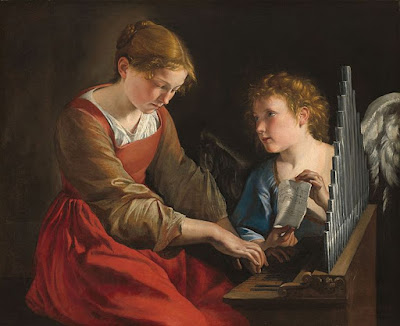
St Cecilia is known as the patron saint of musicians and it is her feast day today 22 November. This painting of St Cecilia and an angel by Orazio Gentileschi (1563 - 1639) and Giovanni Lanfranco (1582 - 1647) really appeals to me. The young woman is concentrating so carefully on playing her organ. The angel is holding the manuscript but Cecilia is not looking at it. Her expression is sad and she seems to be hearing an inner voice to which she is responding. St Cecilia is often portrayed accompanied by an angel. The reason for that lies in the mythical stories about her. She is supposed to have been one of the Christians martyred under the Romans, possibly in Sicily or Rome in the 2nd or 3rd Centuries A.D. The pious legends about her date from the 5th and 6th centuries. You can read one account here . Since she is known as the patron saint of musicians I think one way to celebrate her day is to listen to part of Handel's Ode to St Cecilia and look at some more visual im...

Cost of speaking truth to power: Beheading of John the Baptist

Image
One of the reasons the Bible rings true is that all human life is there: the good, the bad, the ugly and the really horrible. It provides a mirror to humanity at its best, worst and even plain ordinary. It does much more, but that's for other posts. Today is the 'lesser festival' of 'The Beheading of John the Baptist'. It commemorates a truly horrible and sordid story. Caravaggio's painting shown here is one of the less gory depictions of the scene. I wrote about this story from the angle of the women involved over on the Bible Bible Project in 'Women Behaving Badly' and on this blog here . Today I'm thinking about the courage it took for John to fulfill God's call with passion for truth and justice. He was no crowd pleaser among those who held power. John the Baptist's beheading is recorded in the gospels in Matthew 14: 1 - 12 and Mark 6: 1 - 29 . what had John, son of Elizabeth and Zechariah done to deserve such a death and to hav...

Maximilian Kolbe

Image
Above the West door of Westminster Abbey in London are statues of ten 20th century martyrs. Among them stands Maximilian Kolbe, a Conventual Franciscan Friar from Poland who died as Prisoner 16670 in Auschwitz Concentration Camp on 14 August 1941. He had been arrested and imprisoned after sheltering 2000 Jewish people and other refugees from Greater Poland in the Friary in Niepokalanów .  As a radio amateur he had also criticized Nazi activities through his radio reports.   Maximilian Kolbe 1939 photo After a prisoner disappeared from Auschwitz in July 1941, the deputy camp commander selected 10 men to die by starvation and dehydration in the notorious Block 13. Maximilian Kolbe was not one of those selected but he volunteered to take the place of another man, Franciszek Gajowniczek who was crying out for his family. This was accepted. During the weeks that it took the 10 to die Maximilian led the others in prayer and singing. The 4 still left alive after 3 we...

St Andrew's Day

Image
Scotland's national flag, the Saltire, is a symbol of St Andrew, the nation's patron saint. The diagonal cross alludes to Andrew's death by crucifixion. Andrew of course was not Scottish and never visited Scotland. He was a Jewish fisherman from Galilee who responded to Jesus' call to follow him and brought his rather more famous brother Simon Peter with him. It's St Andrew's Day today. It's the only saint's day I remember being celebrated in the Presbyterian church in which I grew up, whose membership was dominated by ex-patriot Scots like my grandparents. Consequently as a child I thought St Andrew was the most important of the first 12 apostles. In the eastern orthodox church he's known as the 1st-called. But in Scotland his importance is more entangled with national identity and often with the struggle for independence - see Flavia di Consiglio's article today for the BBC 'Who owns St Andrew's Day?'  . 1200 years ago in Scot...

Women Behaving Badly

Image
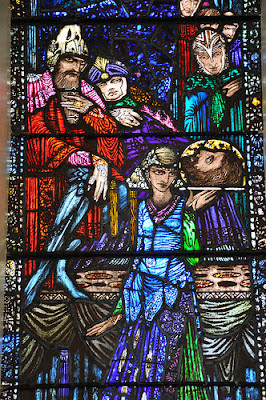
There are some really horrible stories in the Bible. This is about one of them.  Today's name in the Anglican calendar is 'The Beheading of John the Baptist'. You get the picture? This is not going to be a fun post. Digitalnun has posted a reflection on this here that is well worth reading. Mine takes a different angle, a focus on the women involved.  What follows is what I wrote over on The Big Bible Project. It was published there  on 14 August 2012 under the title: Women Behaving Badly Will the inspiration of strong young women who achieve their goals be an enduring Olympic legacy? I hope so, but sadly, women who achieve what they want aren’t always positive examples.  Most women in the gospels provide positive inspiration. Their stories are good news, as are those of so many female athletes. But this is the post I’d rather not write in my ‘Women of the Gospels’ series – but here goes. Who gets the prize for ‘bad’ female role model in the gospels? ...

Man in Striped Pajamas

Image
Do you know the story of Maximilian Kolbe? This statue of him is in  Chrzanów in Poland. Why is he wearing striped pajamas? Because that was his prison uniform. He was prisoner 16670 in Auschwitz where he died on 14 august 1941.  Like many others who died in that camp he wasn't Jewish. He was a Christian, a Roman Catholic friar from Poland. His father was of German ethnic origin and his mother Polish.  With others at his friary in Niepokalanów  during the Nazi occupation gave shelter to huge numbers of war refugees from greater Poland. He helped hide thousands of Jews . As a result he was arrested and sent to Auschwitz . One day when 3 prisoners escaped Karl Fritzsch, the deputy camp commander selected 10 men to be killed by starvation as a reprisal and a deterrent.  Franciszek Gajowniczek was o ne of the 10 selected to die. He began to cry: "My wife! My children! I will never see them again!" Father Kolbe had no wife or children, bu...