Posts

Showing posts with the label climate change

On the need to be seen to be doing something

Image
There's a fine line between doing something because you believe it to be a good thing to do and doing something because of the need to be seen to be doing something. It is easy to decide to do something because your friends are doing it and you do not to want to be left out. It is easy to be pressurised into a particular action because not to act in that way can make you seem weak, uncaring, naive or a traitor to the group. The propaganda used on both sides for recruitment into the military during the 1st World War relied heavily on the need of potential recruits to be seen to be doing their bit and avoid the stigma of being called cowardly or unpatriotic. I am wondering how the need to be seen to be doing something may influence decisions made today in 2 particular areas: Climate Change Syria 1. Climate Change There was an impressive turnout of world leaders at the opening of the Climate Change conference in Paris at the start of this week. Given the global import...

Justice and Protection

Image
The Rio Cuango is one of the richest sources of gem diamonds in Angola, a country where in spite of its rich natural resources including oil, most of the people are poor. The focus of Christian Aid's ' Count Your Blessings' calendar this week is peace and reconciliation. Nowhere is that more needed than in places like Angola after decades of conflict and a civil war that killed and brutalised so many. Christian Aid's partner agencies there work on pressurising the government to protect human rights and invest in essential infrastructure,  HIV prevention and awareness climate change adaptation for secure livelihoods You can read more about this through the links on this page of Christian Aid's website In the UK I have never faced feeling forced to bribe an official in order to get access to a service or something I need. In the last year one in three people in Angola faced such a demand.  Christian Aid suggests today giving thanks for our government a...

What would your ideal world look like?

Image
The problem with having a vision for an ideal world is that it can seem so divorced from what we see now as to be completely unattainable. You might apply that to Christian Aid's picture given in the Count Your Blessings calendar of an ideal world in 2030:  "free from poverty and the effects of  climate change" . Do you, like me, find yourself thinking that the world has never been free from poverty or that climate change is happening and always has however people try to change it? Or that the problem is so big, how can anything 1 person or even 1 nation do to change things? The problem with not having a shared vision of an ideal world is that nobody bothers to do anything about gross injustice or the threats to the health of our planet that we can do something about. Many of the poorest people in the world are already suffering from the effects of climate change such as rising sea levels, drought, extremes of weather. Christian Aid is not suggesting giving mon...

Ducks pay for schooling

Image
The village where I live used to be wetter than today. It still has village ponds, like the one in this photo, but fewer than before. Areas that used to be water-logged or flood are drier due to improved drainage. Availability of communal ponds encouraged cottagers of past times to rear ducks to supplement their incomes as poorly-paid agricultural labourers. The ducks would spend their days on a pond and walk home to their owners to be shut up at night. The ducks are still thriving but most of the cottages of the poor are now 'gentrified'. You need more than back-yard duck-rearing to pay for them. People in water-logged areas of Bangladesh find duck-rearing useful in trying to make a living wage. In Bangladesh today are areas where rivers and groundwater have become salty as a result of climate change. Sea levels are rising, so fresh water near the coast is being salinated. This is making farming by traditional methods harder. One alternative being introduced by CCDB is ...

What does 9 tonnes of CO2 look like?

Image
I had absolutely no idea what 9 tonnes of carbon dioxide looks like, until I looked at this representation of only one tonne in Copenhagen According to the Count Your Blessings Lent calendar from Christian Aid:  9 tonnes is the amount of carbon dioxide generated in Britain by each person per year. So imagine this giant balloon times nine. Or imagine a 27 metre square cube times 9. Here's a 27 metre square cube in a multimedia  art installation in Copenhagen. In Nicaragua each person generates 0.8 tonnes. This central American country is feeling very keenly the effects of climate change, less predictability of weather patterns and greater extremes. You can read about this on this page from Oxfam . Christian Aid suggests today that you give 50p for every flight you have taken in the last 12 months. I've taken 2 (short-haul) flights, so that's £1. 

A trillion plastic bags a year

Image
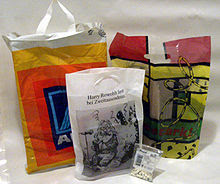
In a week where the focus is caring for the environment, Christian Aid's Count Your Blessings Lent calendar highlights plastic bag use and suggests you give 50p if you have accepted a plastic bag in a shop this week. I was about to say I haven't. I use jute bags or heavy-weight reuseable plastic bags. Then I remembered the several single-use plastic bags I'd used for fruit and vegetables in the supermarket. So my total today should probably be £2.50.  According to Green England a trillion plastic bags each year are used world-wide of which the UK uses 10 billion. Most are only used once and some take as much as 1,000 years to degrade into a plastic dust which can continue to contaminate. Plastic bag litter has a devastating effect on wild-life. It does seem this is a complex issue. If re-cycling is done responsibly, it's not a simple matter of plastic bags = bad, paper and fabric bags = good. For example paper and cotton bags use more energy resources in prod...

What things couldn't you live without?

Image
What items couldn't you live without? That's the challenge from the #cyblessings calendar today, presented in the context of preparing for and responding to natural disasters. Christian Aid works with partners in areas prone to natural disasters, not just to meet emergency needs but to engage in long-term planning for disaster risk reduction. The Humanitarian Practice Network has an interesting article about Christian Aid and Disaster Risk Reduction . It's dated 2007 but I think the points it makes are still relevant. Suppose you lost your possessions in a hurricane or tsunami?   What things would you miss most? I don't count people as 'things' - loss of people would be the greatest loss. The question today is about what things you couldn't live without. Christian Aid suggests giving 10p for every one of those items. Trying to make a list has confronted me with how many things I have that I might miss greatly but actually could live without. The qu...

No poverty in an ideal world

Image
What would your ideal world look like? Fast forward to say the year 2030. What global changes would you like to see by then? Today I learn from Christian Aid's  'Count Your Blessings' Lent calendar that "Christian Aid's ideal world in 2030 would be one free from poverty and the effects of climate change." Christian Aid has a manifesto for change in relation to poverty. it highlights 8 of the global issues that underpin poverty. These are: climate change conflict corruption disaster food and agriculture health inequality tax Christian Aid suggests today that you should "pray for those who are currently living with the effects of climate change." One of the effects of prayer is to change the attitude and behaviour of the person praying. I do believe that prayer changes things, but sometimes God asks us to be the answer to our prayers. Now what might that mean as we pray for a world free of poverty? The countries most vulne...

Climate and Natural Disasters

Image
Sustainability and caring for creation is the theme for this 3rd week of Christian Aid's Count Your Blessings Lent calendar. The United Nations Office for the Co-ordination of Humanitarian Affairs (OCHA) estimates that 70% of natural disasters affecting the world today are climate related. This compares with 50% only two decades ago. This is what OCHA has to say about the humanitarian impact of climate change. "Climate change is not just a distant future threat. It is the main driver behind rising humanitarian needs and we are seeing its impact. The number of people affected and the damages inflicted by extreme weather has been unprecedented.   People who are particularly vulnerable include those whose lives are already threatened by abject poverty, HIV/AIDS, environmental degradation, inadequate housing and insecurity. Those living in disaster hot spots – such as flood plains or cyclone tracks - are exposed to repeated climatic shocks that compound thei...

Raspberries and adapting to climate change

Image
For Northern hemisphere readers here's a foretaste of summer with these succulent raspberries - one of my favourite fruits. Enjoy! This is another day of 'Count Your Blessings' with Christian Aid's Lent calendar 2012 - and the end of a week about change. Providing tools for people to create their own change is key to Christian Aid's work. Working in 47 countries it uses more than 500 partner organisations to empower local people to effect positive change in response to local needs. For example: Christian Aid has 10 partner organizations in Tajikstan . With the collapse of the Soviet Union 20 years ago and a 5 year civil war this country has faced increasing poverty. This is as a result of a deteriorating infrastructure, decline in state-supported services and high unemployment. Food production is threatened due to climate change with more unpredictable weather and rising temperatures. Of a population of 7 million about 2 million have left to find work i...

Life-giving Trees

Image
I'm watching a pair of red kites flying to and from the top of a tree I can see from my study window. They are carrying huge twigs as they build this year's nest. I tried last year to capture this in a photo, but my camera isn't up to it. If you've taken a good photo of a tree you could use it to help 'A Rocha' International plant 800 trees in Ghana where since 1990 one quarter of its forest cover has been felled.  Here's how . Their free environment resource pack for use by churches is 'The Life of Trees and The Tree of Life' . It's coming soon, ready for World Environment Day on 5 June. It should be worth a look.  What a dreadful misuse of our planet that collectively we humans have cleared so much forest, often without thought to replacement or the devastating environmental results. The most widely recognized symbol of Christianity (the cross) is a felled tree. What a dreadful misuse of a valuable resource to crucify someone on a tree.  ...

The Running Clock

Image
Why does time run faster for some of us as we get older? Am I getting slower at doing all those things I think I ought to do, not to mention all that I want to do in the diminshing time I have left? Of course for some people time goes slowly, with pain, boredom or isolation unrelieved by the company of good friends and family and the opportunity to pursue satisfying work and leisure interests, or the luxury of shelter, food and health. We're not all in the same situation. But as far as the dangers for our planet are concerned, within the lifetime of my children and grandchildren, perhaps we are. The idea that time is running out to lessen the damage we've already done to planet earth since the industrial revolution through pollution etc. is being voiced with increasing urgency by many, and especially now as world leaders prepare to gather in Copenhagen.  It's easy to think none of us individually can do much to change things, but as a certain supermarket keeps remind...